Narrative Intelligence · Founders
YOUR PITCH DECK ISN'T
SCORED.
IT HAS AN ATTACK SURFACE.
An investor doesn't grade your deck 0–100. They probe it for the one claim that won't survive a question. Pitchopotamus counts those openings before you meet them in the room.

162s
per deck, on average
The attention economy
2 MINUTES 42 SECONDS.
That's the average time an investor spends on a pitch deck. It's not a long exam: it's a scrutiny. The question isn't «is my deck good?» but «how many exits am I giving them to stop reading?»
Source: DocSend / Dropbox pitch-deck research
Every claim without proof is an open door. Close it yourself, or they'll close it for you.
The model
WHAT THE ATTACK SURFACE IS
Pitchopotamus doesn't assign a grade to your story. It counts the openings: places where a sceptic can enter and break the argument. A claim without evidence is an opening. An assumption presented as fact is another. A number with no source, another. The attack surface is the total count of doors you've left unclosed. Progress is measured in reduction: 9 → 3 openings, not in a score that goes up.
9 → 3 openings · 6 closed
The three failures
WHERE A DECK BREAKS
Three classes of openings Pitchopotamus detects across your argument, before you touch a single design tool.
Does the story need it and never say it?
Claims the argument takes for granted but never defends. A deck that says «we solve the bottleneck» without naming the bottleneck leaves a hole.
Do you present it as fact without testing it?
«We operate in an enormous market» is an assumption dressed as a claim. The investor turns it into a question at second 30.
Where does that figure come from?
A number without a source is an opinion with decimals. «10x more efficient» with no origin isn't data: it's marketing. Pitchopotamus flags every figure that doesn't cite where it's from.
The method
BUILD IT. BREAK IT. DEFEND IT.
Build it
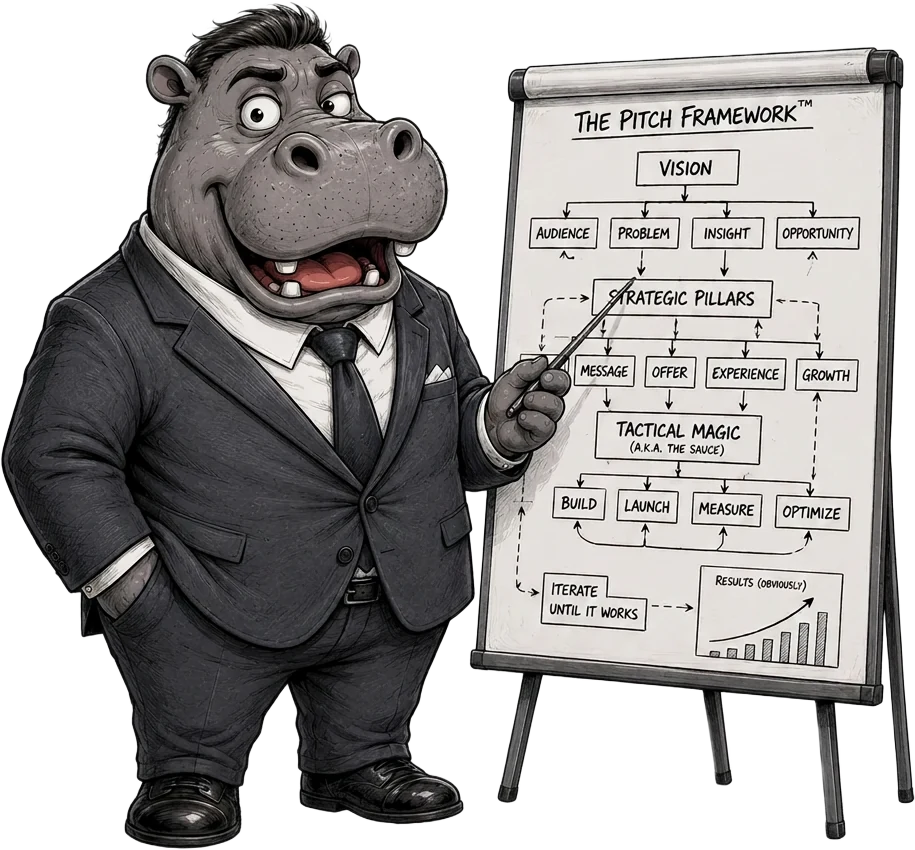
Map the argument slide by slide before opening any design tool. Problem, insight, evidence, traction, ask. Each block is a claim, not decoration.
Break it
Run the attack surface across the whole deck. Pitchopotamus counts holes, assumptions and unsourced numbers, and tells you which to close first: the «fix it first».
Defend it
Close the highest-priority openings, re-test and compare: 9 → 3 openings. The goal isn't perfection, but surviving the first round of questions.
Slide by slide
WHAT AN INVESTOR PROBES ON EACH SLIDE
The canonical investor-deck structure, seen not as «what to put» but as «what opening each block creates».
| Slide | What it scrutinises | The opening it creates |
|---|---|---|
| Problem | Is it a symptom or a real problem? | Naming the pain without naming who hurts and how much. |
| Insight | Is it obvious or counterintuitive? | An obvious insight isn't insight; it's information the investor already had. |
| Solution | Is it a feature or a proposition? | Describing what the product does instead of what it changes for the user. |
| Market | Enormous compared to what? | «Enormous market» with no dimension or source is the most common opening. |
| Traction | Are these your numbers or the sector's? | Market growth presented as if it were yours. |
| Team | Why this team and not another? | A list of names without the «why now and why you». |
| Ask | What are you asking for and for what? | Asking for a figure without explaining what that money buys. |
Examples
PHRASES THAT DON'T SURVIVE 2:42
Real deck phrases, flagged with the rule that catches them. Illustrative, not exhaustive.
| The phrase | Rule | Why it breaks |
|---|---|---|
| «We operate in an enormous market.» | Assumption | «Enormous» with no dimension or source. Enormous compared to what? |
| «Next-generation AI platform.» | Buzzword | Two buzzwords in one sentence. What does it actually do? |
| «10x more efficient than the alternative.» | Unsourced number | Where does the 10x come from? Without a source, it's marketing. |
| «We're going to revolutionise the sector.» | Vague | «Revolutionise» isn't measurable. Name the concrete change. |
| «We have strong traction.» | Vague | «Strong» demands a figure and a period. Without it, it's opinion. |
DOES YOUR DECK SURVIVE
2 MINUTES 42
SECONDS?
Paste your pitch deck's argument into the workshop. Pitchopotamus counts the openings and tells you which to close first. No account, no chat, no compliments.